Guide
Garage Door Won't Close? 7 Things to Check First
If your garage door won't close, first check for objects blocking the doorway, dirty or misaligned safety sensors, and problems with the opener's power or controls. If the door looks crooked, has loose cables, or shows signs of a broken spring, stop operating it and contact a professional.
Start with your symptom
- Door does nothing
Check power and controls. - Door immediately reverses
Check safety sensors and obstructions. - Door closes halfway
Inspect for visible resistance or damage. - Door reaches floor and reopens
Check the threshold; review manufacturer travel guidance. - Door hangs crooked or has loose cables
Stop operation and request professional repair.
You press the button. The garage door starts moving down.
Then it stops. Or reverses. Or refuses to move at all.
Now your garage is open, your plans are interrupted, and your garage door has apparently decided it's done working for the day.
Here are seven things to check before deciding what to do next.
Quick Guide: What Is Your Garage Door Doing?
| Symptom | Possible cause | First step |
|---|---|---|
| Door starts closing, then reverses | Safety sensor obstruction or mechanical resistance | Check the doorway and sensors |
| Door won't move down at all | Opener, controls, sensors, or mechanical problem | Check power and visible warning signs |
| Opener lights flash | Model-specific diagnostic warning | Check the manufacturer's instructions |
| Door closes only while holding the wall button | Possible safety sensor issue | Inspect sensors without bypassing them |
| Door moves unevenly | Cable, track, roller, or spring problem | Stop operating it |
| Door reaches the floor, then reverses | Travel setting or mechanical issue | Consult the opener manual |
| Door is stuck open at night | Multiple possible causes | Prioritize safety and securing the property |
1. Check for Anything Blocking the Door
Start with the simplest possibility.
Look across the garage door opening from a safe position.
A bicycle, storage bin, broom, fallen tool, or other object may be interfering with the door's travel or safety system.
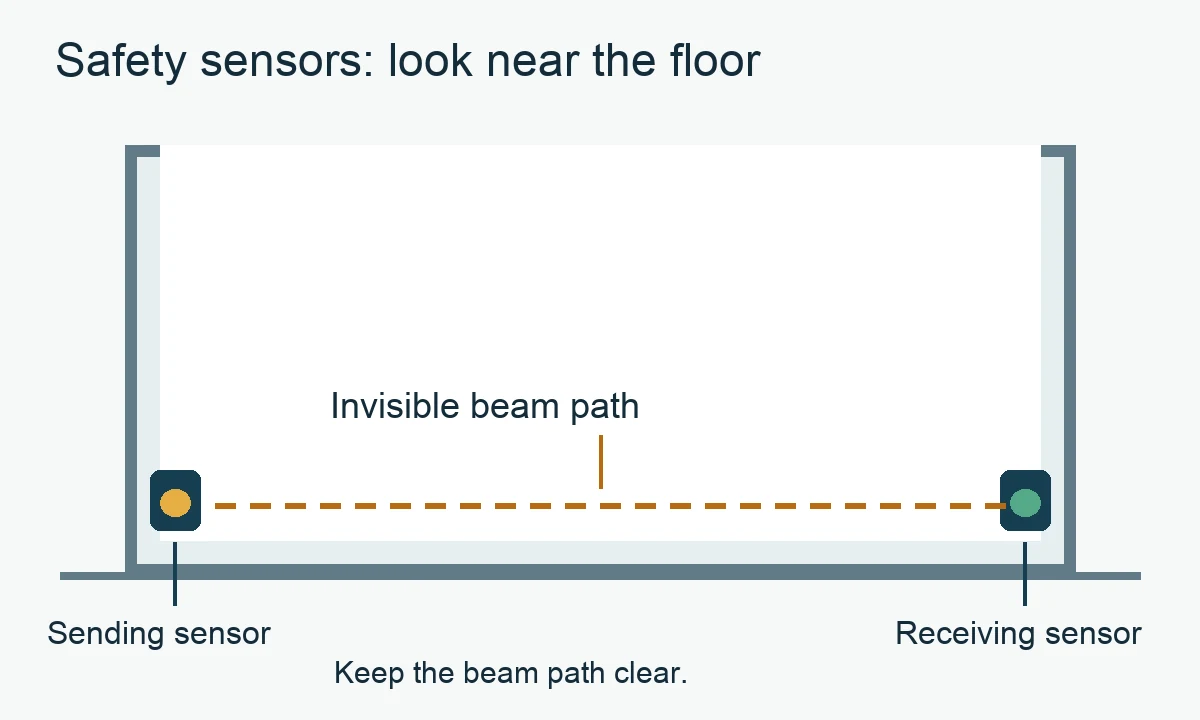
Check whether anything is blocking the path between the safety sensors near the bottom of the doorway.
If you can remove an ordinary loose object without entering the door's travel path or touching moving hardware, clear it away.
Then try the normal wall control once.
If the door continues reversing or stops unexpectedly, don't repeatedly cycle it.
2. Inspect the Garage Door Safety Sensors
Most modern residential automatic garage doors use photoelectric safety sensors near the bottom of the opening.
One sensor sends an invisible beam to the other. If the beam is interrupted or the system detects a problem, the opener may prevent the door from closing normally.
What to look for
- Something blocking the beam.
- Dirt, dust, or cobwebs on a sensor lens.
- A sensor that appears bumped or out of alignment.
- Loose or visibly damaged wiring.
- Diagnostic lights that differ from their normal appearance.
You can gently clean accessible sensor lenses with a soft cloth.
Check that nothing is blocking their line of sight.
Avoid pulling wiring, dismantling brackets, or making electrical repairs.
Different opener models use different indicator lights, so consult your manufacturer's instructions before interpreting their meaning.
Never bypass or disable the safety sensors to make the door close.
For model-specific help, see Chamberlain Group’s safety-sensor troubleshooting. Keep the safety system enabled.
3. Check the Opener's Power and Controls
Sometimes the problem isn't the garage door itself.
It may be the control system.
If the opener doesn't respond, check whether the wall control has power or displays an indicator.
If safe and accessible, confirm that the opener is connected to power and check whether other garage electrical devices are working.
If the wall control works but the remote doesn't, the remote battery or programming may be involved.
Some openers also have a lock or vacation mode that disables remote operation.
Important distinction
If the motor runs but the door doesn't move, don't assume the issue is electrical.
The opener's drive mechanism or the door's mechanical components may be involved.
Stop if you hear grinding, straining, or other unusual noises.
For more information, see our garage door opener problems guide.
4. Look for Obvious Track or Roller Problems
A garage door moves along tracks with rollers.
If a roller is displaced, a track is bent, or the door binds during movement, the opener may stop or reverse.
Look from a safe distance for:
- Bent or damaged tracks.
- Rollers outside the track.
- Panels that appear twisted or misaligned.
- Hinges or brackets that look damaged.
- Objects caught in the track.
- A door that hangs unevenly.
Don't try to straighten the track with a hammer.
Don't force a roller back into place.
Don't loosen brackets or reach into a jammed mechanism.
Garage door hardware can be under significant tension, and an unstable door can move unexpectedly.
If the door looks crooked or off track, stop operating it.
Read our garage door off-track guide for additional warning signs.
5. Watch for Broken Springs or Damaged Cables
Garage door springs counterbalance much of the door's weight.
Cables help transfer that lifting force.
When a spring or cable fails, the door may become difficult to move, uneven, or unsafe.
Warning signs
- A loud bang from the garage.
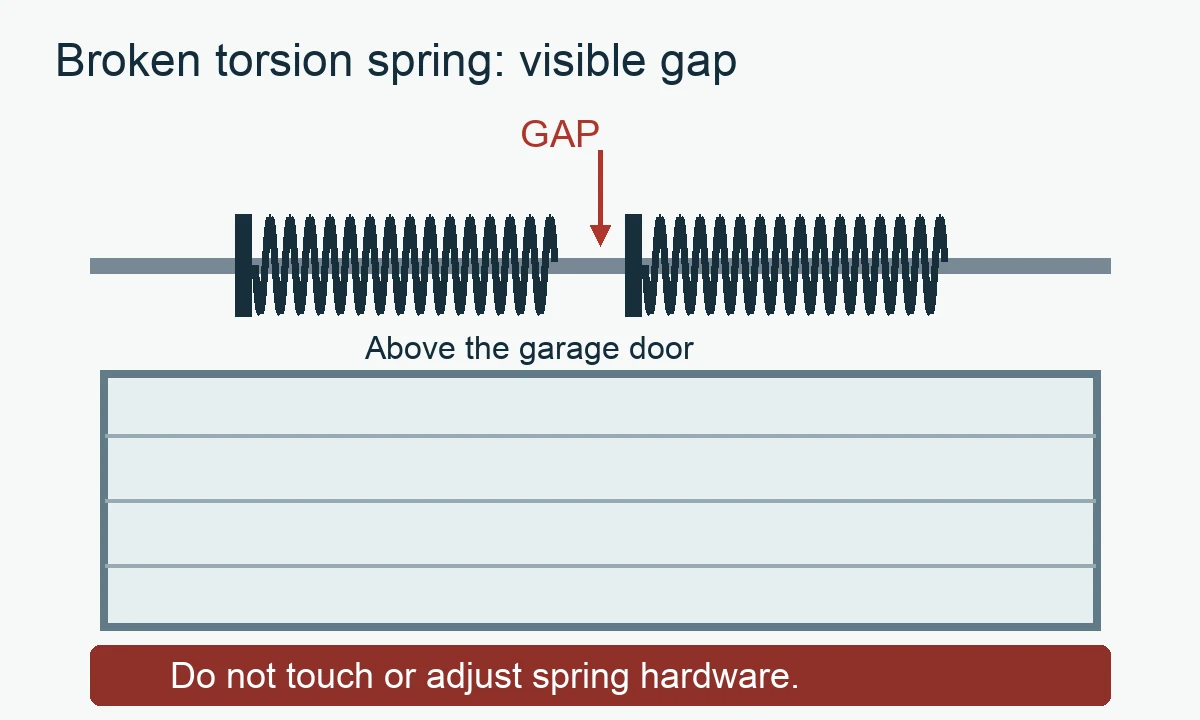
- A visible gap in a torsion spring above the opening.
- A loose, hanging, or frayed cable.
- One side of the door sitting higher than the other.
- The opener struggling or stopping.
- The door moving unpredictably.
Do not attempt to operate or manually lift a door with a suspected spring or cable failure.
Do not pull the emergency release while the door is partially open or unstable.
Never attempt to adjust spring tension or cable hardware yourself.
These problems require professional diagnosis and repair.
See our broken spring signs guide.
See DASMA’s garage door safety recommendations for spring and cable warnings.
6. Check the Opener's Diagnostic Lights or Error Codes
Modern garage door openers often provide diagnostic information through flashing LEDs, arrow indicators, wall-control messages, or connected apps.
The meaning depends on the manufacturer and model.
For example, a diagnostic pattern may indicate a sensor problem, travel issue, or other fault.
Before changing settings, record:
- The opener's brand and model.
- Any error code or flashing-light pattern.
- Whether the door begins moving before stopping.
- Whether the problem happens every time.
- Any unusual sound.
Then consult the manufacturer's official troubleshooting instructions.
Avoid relying on generic online advice that treats every opener as though it uses the same codes.
Use the official Chamberlain/LiftMaster diagnostic-code guide for your model.
7. Consider the Door's Travel Settings — But Don't Force It
If your garage door travels down to the floor and then reverses, the opener's travel settings may be involved.
However, mechanical resistance or damaged components can produce similar symptoms.
Some openers require specific travel-setting procedures and safety tests after adjustments.
Don't increase the closing force to overcome an unexplained problem.
Excessive force can interfere with safe operation.
If the door repeatedly reverses at the floor, consult the model-specific manual or arrange professional service.
Review Chamberlain’s incomplete-travel guidance alongside your model’s instructions. Do not use adjustments to overcome damage or binding.
What If the Garage Door Won't Close at Night?
A garage door stuck open after dark creates an additional security concern.
But an unsecured garage is not a reason to take risks with damaged equipment.
If the door is crooked, partially suspended, or showing signs of spring or cable damage, keep clear of it.
Don't attempt to pull it down by force.
Don't disconnect the opener unless you know the door is stable and the manufacturer's procedure is safe for your situation.
Keep children and pets away from the opening and avoid leaving valuables exposed where practical.
If you need repair assistance, explain that the garage door is stuck open and ask about available service times.
Emergency service is not guaranteed and must be confirmed with the provider.
When Should You Call a Garage Door Repair Professional?
Contact a professional if:
- The door keeps reversing after basic obstruction and sensor checks.
- The opener strains, grinds, or stops unexpectedly.
- The door is visibly crooked or off track.
- A spring or cable appears damaged.
- The door is partially open and unstable.
- You suspect an electrical or mechanical failure.
- You cannot safely identify the problem.
A technician can assess the counterbalance system, tracks, rollers, opener, sensors, and safety reversal operation.
The goal is to repair the actual cause rather than repeatedly forcing a malfunctioning door.
Garage Door Won't Close? Get Repair Help
Your garage door should close when you tell it to.
Not after fifteen attempts, a motivational speech, and a negotiation with the wall button.
If basic checks don't resolve the issue, stop operating the door and get help diagnosing it.
Call (260) 450-8050 to discuss your garage door repair inquiry, or use the callback form on this page.
BackwardsLA Leads is a referral service. We do not perform garage door repairs ourselves. Calling or submitting an inquiry does not guarantee immediate service or contractor availability.
Garage Stuck Open? Tell Us What’s Happening.
Describe what your garage door is doing, where you’re located, and how we can reach you. We’ll use those details to help route your repair inquiry where service is available.
Call (260) 450-8050Frequently Asked Questions
Why does my garage door start closing and then go back up?
The opener may detect an interrupted safety sensor beam, mechanical resistance, or a travel-related problem. Check for visible obstructions and consult the model-specific diagnostic instructions.
Why won't my garage door close even though nothing is blocking it?
Dirty or misaligned sensors, damaged wiring, opener faults, travel settings, or mechanical problems may be responsible. A clear doorway doesn't rule out a sensor or hardware issue.
Why does my garage door only close when I hold the wall button?
On some opener models, this behavior can indicate a safety sensor issue. Check the manufacturer's instructions. Don't use the wall control to bypass a malfunctioning safety system.
Can I close my garage door manually?
Only when the door is stable, properly balanced, and the manufacturer's instructions permit it. Do not disconnect or manually move a door with suspected spring, cable, or track damage.
Why do my garage door opener lights flash?
Flashing lights may indicate a diagnostic condition. The meaning varies by model, so check the official manual rather than assuming a universal code.
Should I adjust the garage door opener's force?
Not to overcome unexplained resistance. The door or opener should be diagnosed before force or travel adjustments are considered.
Is a garage door that won't close an emergency?
It can be urgent when the property cannot be secured or the door is unstable. Keep clear of damaged equipment and ask a repair provider about actual availability.
Bottom line: If your garage door won't close, start with visible obstructions, safety sensors, and opener controls. If the door is damaged, crooked, or mechanically unstable, stop operating it and request professional repair.
A working garage door shouldn't require a daily argument.