Guide
Why Won't My Garage Door Open? 9 Things to Check
BackwardsLA Garage Door Repair | Homeowner Guide | October 23, 2026
Before You Start
You hit the garage door button.
Nothing.
You hit it again, because apparently the first time wasn't convincing enough.
Still nothing.
Now you're standing in your garage, holding your keys, staring at a door that has apparently decided to take a personal day.
Fantastic.
Before you start pricing an entirely new garage door—or pressing the remote another 47 times—there are a few things worth checking.
If your garage door won't open, the problem could be a dead remote battery, lost power, a manual lock, a broken spring, or a malfunctioning opener. Start with the simple checks. If the door looks crooked, has damaged cables or springs, or makes unusual mechanical noises, stop operating it and call a professional.
Here's how to narrow things down without making the situation worse.
First: What Is Your Garage Door Actually Doing?
A garage door that won't open can behave several different ways.
And those differences matter.
These are possibilities, not guaranteed diagnoses.
Think of this as gathering clues before deciding what to do next.
Safety comes first: Never try to force open a door that looks damaged or unstable. Garage doors are heavy, and their spring systems can store dangerous amounts of energy.
| What happens | Possible cause |
|---|---|
| Nothing happens when you press the button | Power, remote, or opener problem |
| The wall button works, but the remote doesn't | Remote battery, programming, or lock mode |
| The motor hums but the door stays put | Opener or mechanical problem |
| The door moves a few inches and stops | Spring, track, balance, or opener issue |
| You heard a loud bang | Possible broken spring |
| The door hangs crooked | Possible cable, roller, or track damage |
1. Check the Power Before Assuming Something Expensive Broke
Let's start with the obvious.
Your garage door opener needs electricity.
If it's not getting any, that remote in your hand is essentially a very small paperweight.
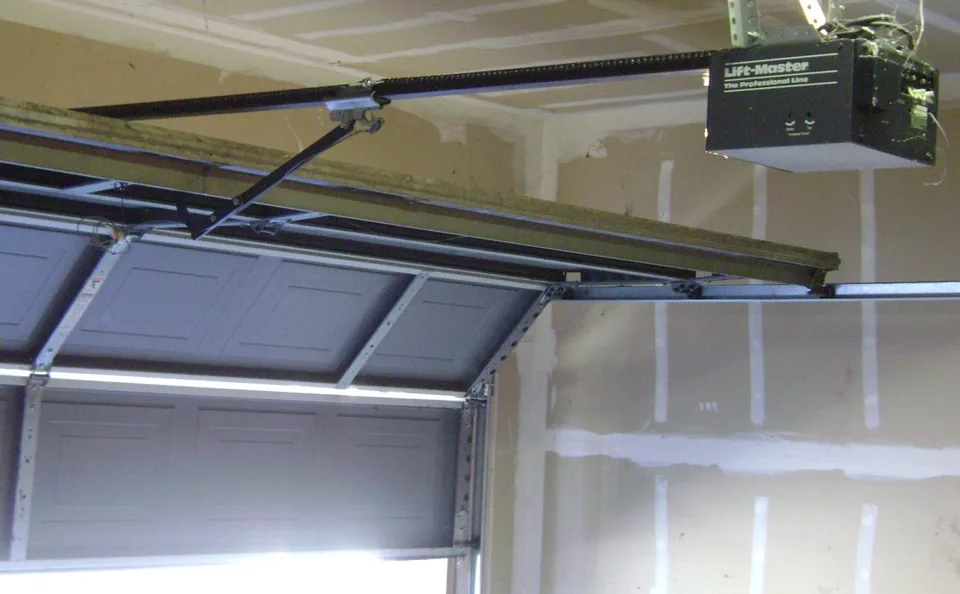
Look at the opener mounted near the ceiling.
Are any indicator lights on?
Try the wall-mounted button.
If there's no response, check whether other electrical devices in the garage are working.
You can also check an accessible circuit breaker or GFCI outlet.
If the opener's plug is safely accessible, make sure it hasn't come loose.
Some openers have battery backup systems, so behavior during a power outage varies by model.
What not to do: Don't open the motor housing, handle exposed wiring, or climb around garage door hardware.
If the power appears normal but the opener is still completely unresponsive, it may need professional attention.
The good news? Checking the power costs nothing.
That's a pretty solid place to start.
2. Try the Wall Button Instead of the Remote
Here's a useful question:
Does your garage door work when you press the wall button but refuse to respond to the remote?
If so, the door itself may be perfectly fine.
Try replacing the remote battery.
Check whether the remote is visibly damaged.
Some garage door openers also have a lock or vacation feature that disables remote operation.
Your owner's manual can help you identify that feature.
If you have another compatible remote, testing it may also help narrow down the problem.
Imagine thinking your entire garage door system was broken when all you needed was a battery.
We've all spent money on worse misunderstandings.
3. Listen to the Sounds Your Garage Door Makes
Garage doors aren't particularly conversational.
But they do communicate.
And sometimes the noises tell you more than the remote does.
Clicking: The opener may be receiving a signal but failing to operate. Electrical and mechanical faults can both produce clicking sounds.
Humming: The motor may be running or attempting to run while the door remains stuck.
Grinding: Worn or damaged mechanical components may be creating friction.
A loud bang: A garage door spring may have broken.
Scraping or rattling: There may be a problem with rollers, tracks, or other hardware.
Don't keep pressing the button to investigate a concerning sound.
One normal attempt can provide useful information. Repeated attempts against a damaged door may create additional problems.
Make a mental note of what you heard.
If you call a technician, explaining that the motor hums but the door doesn't move is more useful than saying, "It makes that noise."
Although, admittedly, we've all described mechanical problems that way.
4. Check for a Broken Garage Door Spring
This is one of the more serious possibilities.
Garage door springs counterbalance much of the door's weight.
Without that assistance, the door can become extremely difficult—or dangerous—to move.
Many residential doors have torsion springs mounted above the opening. Others use extension springs alongside the tracks.
You don't need to touch either type.
Look from a safe distance for obvious warning signs:
- A visible gap in a torsion spring
- A loud bang before the door stopped working
- A door that barely lifts
- A door that moves unevenly
- Loose or damaged cables
Leave spring repairs to a professional
A broken spring doesn't necessarily mean the entire door needs replacing.
But it does mean you need someone qualified to inspect the system.
The Door & Access Systems Manufacturers Association (DASMA) provides garage door safety guidance and emphasizes the dangers associated with high-tension components.
Do not attempt to adjust, wind, or replace garage door springs yourself.
And don't try to help a struggling opener by lifting a door with a suspected broken spring.
This is not the moment for a heroic home improvement experiment.
5. The Motor Runs, but the Garage Door Won't Move
You press the button.
The motor starts.
The door doesn't.
Wonderful.
This situation can have several explanations.
The opener's drive system may be damaged.
The opener may be disconnected from the door.
A spring may have failed.
Or the door could be physically obstructed or mechanically jammed.
The important thing is not to assume the motor needs replacing.
An opener is only one part of a larger mechanical system.
If you hear the motor running but the door doesn't move normally, stop operating it.
Repeatedly activating the opener may damage additional components.
A technician can determine whether the problem involves the opener, the door, or both.
6. Check Whether the Door Is Manually Locked
Some garage doors have manual locks.
If the lock is engaged, the automatic opener may be unable to lift the door.
Look for an accessible locking mechanism and consult the manufacturer's instructions.
Don't force the opener against a locked door.
And don't attempt to manipulate a lock if the door is damaged or under unusual tension.
This is another reason to start with simple observations.
A locked door and a broken opener can look surprisingly similar from the driver's seat.
One requires an appropriate lock check.
The other may require a repair.
Big difference.
7. What If the Door Opens Halfway and Stops?
This one is particularly frustrating.
The door starts moving.
For about three seconds, everything looks normal.
Then it changes its mind.
A door that opens partway and stops may have worn rollers, damaged tracks, spring problems, mechanical resistance, or opener issues.
Look for visible problems without touching moving parts.
Is the door crooked?
Does a cable appear loose?
Does the track look bent?
If anything appears damaged, stop using the door.
Don't try to straighten a track or reconnect a cable.
Also, don't immediately start adjusting the opener's force settings.
Those settings affect how the system operates and responds to resistance. Incorrect adjustments can create safety hazards.
The goal isn't to trick the opener into lifting the door.
The goal is to fix whatever is preventing normal movement.
8. Be Careful With the Emergency Release
Many automatic openers have a red emergency release cord.
You may have seen videos telling homeowners to pull it and lift the door manually.
Here's what those videos don't always explain clearly enough:
Disconnecting the opener doesn't make a damaged garage door safe.
If a spring is broken, the door may be much heavier than expected.
If a cable has failed, the door may be unstable.
And if the door is partially open, disconnecting the opener could allow it to move unexpectedly.
Never use the emergency release on a raised or visibly damaged door.
If the door is fully closed, appears undamaged, and your manufacturer's instructions permit manual operation, follow those instructions.
If you're unsure about the condition of the door, leave it alone.
Being late to work is annoying.
An uncontrolled garage door is a considerably bigger problem.
9. Indiana Winters Can Make Garage Door Problems Worse
If you live in Fort Wayne, Kokomo, West Lafayette, or anywhere else in Indiana, you already know winter doesn't mess around.
Cold weather can make existing garage door problems more noticeable.
Water can freeze around the bottom weather seal.
Snow and ice can interfere with movement.
And aging components may struggle when conditions change.
If your garage door appears frozen to the ground, don't repeatedly activate the opener hoping it'll break free.
That can put unnecessary stress on the system.
Check for visible snow or ice from a safe position.
Avoid boiling water, sharp tools, and excessive force.
If the door remains stuck or shows signs of damage, arrange professional assistance.
A little preventive maintenance before winter can help reduce avoidable surprises.
Because nobody wants to start a January morning negotiating with a frozen garage door.
What If Your Garage Door Opens but Won't Close?
That's a related problem, but the likely causes can be different.
Modern automatic garage door systems typically use safety reversing sensors near the bottom of the opening.
These sensors help detect obstructions.
If the door opens normally but refuses to close, check whether something is blocking the doorway.
You can also inspect accessible sensor lenses for dirt.
Some opener models display diagnostic lights or error codes.
For example, Chamberlain's troubleshooting guidance discusses common closing problems and safety sensor alignment.
Always follow the instructions for your specific opener.
Never bypass or disable the safety sensors to force the door to close.
They're there for a reason.
And that reason is more important than getting the garage shut five minutes faster.
How Much Does It Cost to Fix a Garage Door That Won't Open?
It depends on what's broken.
A remote battery is one thing.
A failed torsion spring is another.
And replacing an opener is different from repairing a damaged cable or track system.
The total cost can depend on the parts required, labor, door size, equipment model, and whether emergency service is needed.
Before agreeing to a repair, ask three questions:
- What exactly failed?
- What repair do you recommend?
- What's the total estimated price, including parts and labor?
Understand your repair options
If a contractor recommends additional work, ask why.
You don't need to be a garage door expert to understand what you're paying for.
And remember: a garage door that won't open doesn't automatically need replacing.
Sometimes repairing a component is the appropriate solution.
A qualified technician can assess the door's condition and explain your options.
When Should You Stop Troubleshooting?
Here's a simple rule.
If the issue involves a spring, cable, track, door balance, or unpredictable movement, stop.
The same goes for electrical damage or malfunctioning safety features.
Checking a remote battery is reasonable.
Trying to repair a spring under tension is not.
You don't need to become a garage door technician in the next 20 minutes.
You just need to recognize the difference between a basic check and a potentially dangerous repair.
That's a skill worth having.
Need Garage Door Repair in Fort Wayne?
When your garage door stops working, you want answers.
You want to know what might be wrong, whether it's safe, and who can help fix it.
You probably don't want to spend your entire morning sorting through search results.
That's why we're building BackwardsLA Garage Door Repair.
We're creating a service that connects homeowners with independent local garage door repair companies.
We don't perform the repairs ourselves.
Our job is to make finding repair assistance easier.
Garage door stuck? Let's get it working again.
Our local phone referral service is being prepared. Calling and contractor availability will be announced when the service is operational.
Frequently Asked Questions
Why won't my garage door open even though the motor runs?
Possible causes include a broken spring, failed opener component, disconnected drive system, or mechanical obstruction. Stop operating the door if it isn't moving normally.
Can I open my garage door if the spring is broken?
Don't attempt to manually lift or operate a door with a suspected broken spring. Contact a trained technician.
Why does my garage door work with the wall button but not the remote?
The remote battery, programming, or opener lock mode may be responsible. Consult the manufacturer's instructions.
Can freezing weather stop a garage door from opening?
Yes. Ice and snow can obstruct the door, while cold conditions may expose existing mechanical problems.
Does a garage door that won't open need to be replaced?
Not necessarily. Many problems involve repairable components. A professional inspection can help determine the appropriate solution.